Kenyan banks were ahead of the curve on cheque truncation — Sybrin CTS has been running since 2011, T24 host files are humming, and the clearing pipeline works. But if you work at a bank in Nairobi or Mombasa, you also know where the real friction lives: handwritten cheque amounts that still get keyed by hand, signature checks that rely on memory and a crowded teller queue, and an audit trail that lives in three different log files.
Meanwhile customers are asking for mobile deposit, and fraudsters keep getting better at what they do.
This guide is for the teams who run that infrastructure day to day. It maps out exactly what's running in most Kenyan banks — Sybrin, NCR, Finteq, T24, the scanners, the host files — and shows where AI validation fits as a practical add-on, not a rip-and-replace project.
Kenyan banks were early adopters of cheque truncation. The Central Bank of Kenya operationalised the Cheque Truncation System (CTS) in 2011, reducing the clearing cycle from T+3 to T+1 and replacing interbank physical courier with electronic image exchange. (Central Bank of Kenya)
But here is the challenge that is less visible from outside a bank's operations: the CTS modernised interbank clearing. It did not fully modernise the intrabank capture pipeline that feeds into it. Most Kenyan banks still operate a heterogeneous presenting-bank environment where capture hardware, validation logic, and core-banking integration run on different generations of technology.
This post explains what that infrastructure actually looks like, where the weak points are, and how AI-powered validation can be added as a layer — working alongside Sybrin, NCR, Finteq, T24, and the existing host-file and image-transfer pipelines.
1. The Kenyan Presenting-Bank Environment: What Is Actually Running
If you work in technology at a Kenyan commercial bank, you know that "the cheque system" is not a single application. It is a stack:
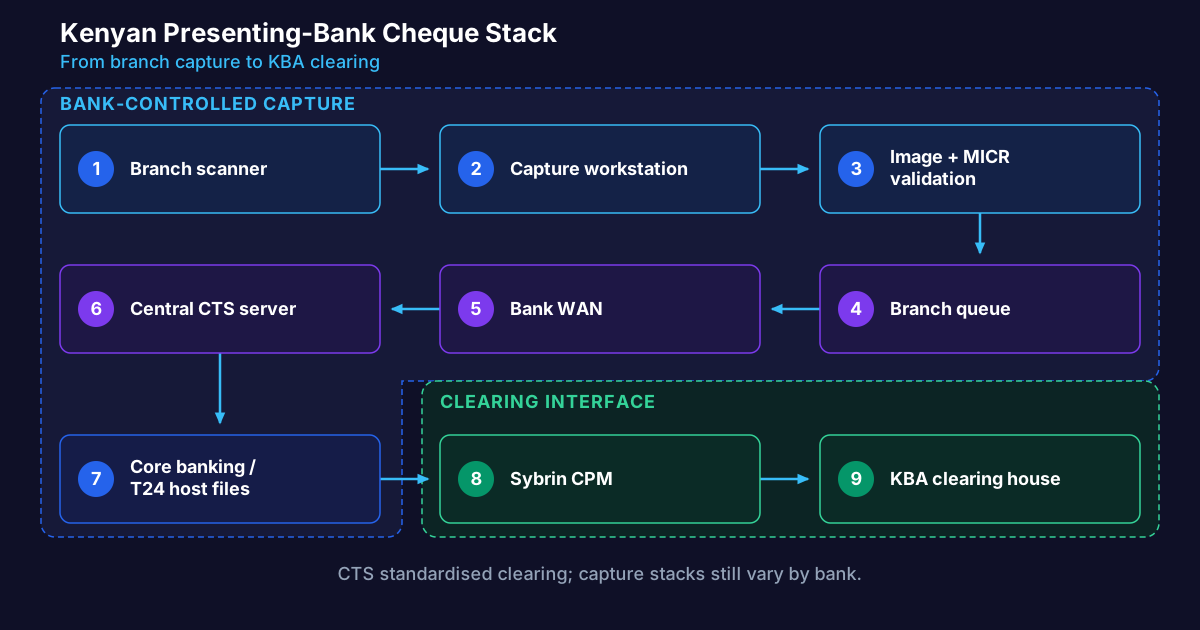
The clearing interface is standardised, but the capture systems feeding it still vary by bank.
1.1 Clearing and Participant Layer: Sybrin
The Kenya Bankers Association operates the automated clearing house. Sybrin supplied the central clearing software and the participant interface — known as the Client Participation Module (CPM) — that each bank runs to submit and receive clearing items. (Developing Telecoms)
This means every participating bank has a Sybrin component at the gateway to the clearing house. But the Sybrin CPM is downstream of the bank's own capture and validation infrastructure. It receives files that are already prepared by the bank's internal systems.
1.2 Capture and Imaging: Heterogeneous
The capture environment — where the physical cheque becomes a digital item — was never standardised across Kenyan banks. Historical implementations include:
- NCR Kenya provided imaging and document-management solutions to several banks, including Standard Chartered.
- EFT Kenya / Finteq delivered cheque truncation, electronic data transfer, document management, image access, and internet banking integration for the National Bank of Kenya. (Business Daily Africa)
- Other banks procured their own capture workstations and scanners independently.
Today, the capture workstation is likely one of:
- A Windows thick client with vendor scanner SDKs (TWAIN, ISIS, or proprietary).
- A browser-based application using a local hardware bridge such as Sybrin's WebAssist to access scanners and MICR readers.
- A branch back-office scanning station that processes batched cheques from multiple tellers.
1.3 Core-Banking Integration: Often T24 with Host Files
A 2018 Central Bank of Kenya procurement specification for a cheque-processing system required:
- LAN operation integrated with the bank's core system.
- Data exchange through flat files and extracts in bank-defined formats.
- Integration with Temenos T24 Release 9.
- Generation of host files, database tables, and cheque-image transfer into T24.
- Configurable host-file structures without vendor intervention.
This host-file pattern is operationally sensible — it decouples the capture and clearing release cycles, provides strong batch-level control totals, and enables straightforward retry and replay. But it also means that adding new validation logic or data fields requires coordinated schema changes across multiple systems.
1.4 Scanner Hardware
A typical Kenyan bank capture environment uses scanners with:
- MICR reading (E13B and CMC7 magnetic-font support).
- OCR-A, OCR-B, and universal optical character recognition as a fallback when the magnetic read fails.
- At least three output pockets for sorted disposition of successfully captured items, repair items, and exceptions.
- Image acquisition at a resolution sufficient for the CTS clearing stream.
The standard Kenyan cheque size of 7 × 4 inches (established by the CBK CTS framework) simplifies scanner configuration, but the actual scanner make, model, driver interface, and image encoding vary by bank and branch.
2. Where the Capture Pipeline Falls Short
Despite the CTS infrastructure and the standardised clearing format, most Kenyan banks share a set of operational pain points in the capture pipeline.
2.1 Handwritten and Colloquial Amounts
The CBK CTS FAQ specifies that the collecting bank sends a cheque image, MICR code-line data, and the cheque amount. But it does not specify how the amount is obtained.
In practice, the amount may be:
- Keyed by the teller at deposit time.
- Entered by a capture operator viewing the image.
- Dual-keyed for verification.
- Read by a courtesy-amount recognition (CAR) engine.
For handwritten cheques — which are common for business-to-business payments and individual account holders — the amount in figures can be ambiguous, and the amount in words (legal amount) may contain colloquial phrasing, mixed languages (English and Swahili), or cursive handwriting that generic OCR engines cannot parse reliably.
When the amount cannot be read automatically, the item enters a manual repair queue. That slows the clearing pipeline, increases cost, and introduces data-entry error risk.
2.2 Manual Signature Verification
Signature verification at most Kenyan banks still relies on visual comparison against a specimen card or scanned image stored in the core banking system. At busy branches, this is a bottleneck. The verifying officer may be unfamiliar with the account holder, the specimen may be out of date, or attention fatigue can lead to missed forgeries.
Nigerian banks alone recorded NGN 837.7 million in cheque-related fraud losses in Q1 2025. East African banks face similar exposure, particularly for forged signatures on high-value instruments.
2.3 Audit Trail Fragmentation
The CTS clearing house has its own audit trail — it knows which items were submitted, acknowledged, and returned. But the intrabank audit trail — who captured the image, who entered the amount, who verified the signature, who approved the correction — lives across multiple systems:
- The capture workstation log (if it records user actions).
- The core-banking transaction log.
- The Sybrin CPM submission log.
- Manual records if the repair queue is paper-based or spreadsheet-driven.
For banks that need to respond to regulator inquiries, dispute investigations, or external audit requests, reconstructing a single item's full lifecycle across these disparate logs is laborious.
2.4 Duplicate Detection and Image Quality
The Sybrin DocFlow platform advertises 21 automated image-quality checks and duplicate detection capabilities. But whether these run at the presenting bank's capture point or at a downstream processing stage depends on the bank's specific deployment.
If duplicate detection runs centrally — after the item has already been transmitted — a duplicate can waste clearing resources and create reconciliation headaches. Running it at the point of capture is more effective, but requires local processing capability that many banks' current capture workstations lack.
2.5 Limited API and Mobile Channel Integration
The host-file and flat-file integration model works well for branch-based capture, but it does not easily support mobile cheque deposit — where a customer photographs a cheque using a smartphone and submits it for clearing.
To offer mobile deposit, a bank needs:
- Image quality assessment on the device or at the server edge.
- OCR and MICR extraction from a phone photograph (not a flatbed scan).
- Real-time validation feedback to the customer.
- Secure image transfer to the capture pipeline.
These requirements do not fit naturally into a batch-oriented host-file workflow. Banks that want mobile deposit must either build a parallel pipeline or overlay modern processing onto the existing infrastructure.
3. How to Layer AI Validation onto Existing Infrastructure
The most practical path for Kenyan banks is not to replace the existing capture stack. It is to insert AI-powered validation as an enhancement layer that works alongside the Sybrin CTS pipeline, the existing core-banking integration, and the current scanner hardware.
3.1 Integration Point: After Capture, Before Core
The ideal insertion point is between the capture workstation and the core-banking host-file integration:
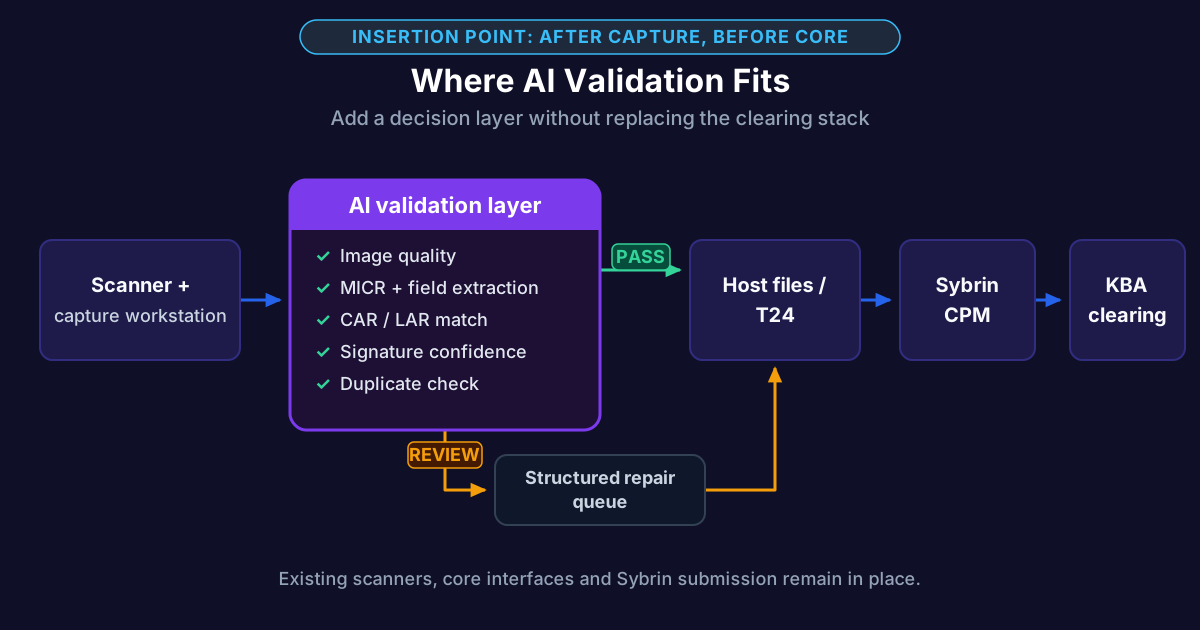
At this point, the AI layer receives:
- The cheque image (front and back).
- The MICR code-line data.
- The amount (from the deposit transaction or operator entry).
It returns:
- Extracted and validated fields in structured JSON or host-file format.
- Confidence scores for each field.
- A reconciliation result: courtesy amount vs. legal amount match or mismatch.
- A signature verification pass/fail with confidence.
- Image-quality assessment result.
- Duplicate detection result (against historically processed items).
- An immutable audit record of every step.
Items that pass all validations proceed automatically to the host-file pipeline. Items that fail are routed to a repair queue with specific guidance on what needs correction.
3.2 Working with Host Files and Flat Files
For banks that use T24 or another core platform with flat-file integration, the AI layer can:
- Read the existing host-file format as input (if the capture system already generates one).
- Add validated fields and confidence scores to the record.
- Output a host file in the same format, enriched with the new data.
- Generate a separate audit file that associates each item's validation results with the transaction.
This means the core-banking integration does not need to change. The host-file schema stays the same. New fields can be added in optional extensions or mapped to existing fields.
3.3 Image Quality and Duplicate Detection at the Point of Capture
Unlike downstream validation that runs at the processing centre, the AI validation layer can run at or near the point of capture:
- At the branch workstation: A lightweight model validates image quality, checks for duplicates against a local cache, and provides immediate feedback to the operator.
- At the regional hub: A full model suite runs CAR/LAR reconciliation, signature verification, and exception routing.
- At the processing centre: Batch reconciliation and audit-file generation.
This distributed architecture mirrors the reality of Kenyan banking — where urban branches may have reliable connectivity and central processing, but upcountry branches need local validation before transmission.
3.4 Mobile Deposit Enablement
For banks that want to add mobile cheque deposit without building a separate pipeline, the AI validation layer can serve as the mobile processing engine:
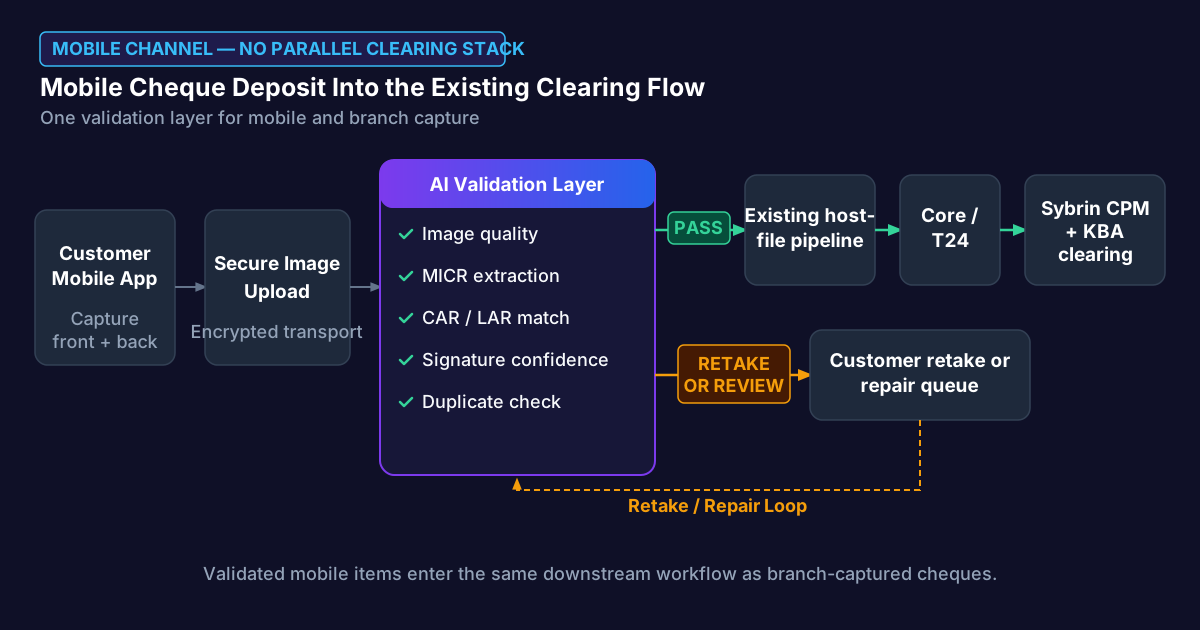
The validated item is then injected into the existing host-file flow as if it had been captured at a branch workstation. The core-banking system and Sybrin CPM see no difference.
3.5 On-Premise Deployment for Data Sovereignty
Central Bank of Kenya regulations impose requirements on where customer data can be stored and processed. Many Kenyan banks require that cheque images and associated data remain within national borders — or within the bank's own infrastructure.
The AI validation layer can be deployed:
- On-premise at the bank's data centre: Full control, no data leaves the bank's network.
- On a local server at the processing centre: For banks with centralised cheque operations.
- As a lightweight edge service at regional hubs: For distributed processing.
Inference runs locally. Model updates are deployed through the bank's own change management process. No cheque images or extracted data are sent to external cloud services.
4. Comparison: Chequedb vs. Generic Approaches
| Capability | Generic OCR / Cloud AI | Chequedb |
|---|---|---|
| Handwriting recognition | Limited to block print; fails on cursive or colloquial amounts | Field-specific models trained for cheque handwriting including mixed scripts |
| Legal amount / courtesy amount reconciliation | Not available | CAR vs. LAR comparison with configurable mismatch handling |
| Kenyan cheque formats | Must be trained from scratch; no prebuilt support | Trainable on KBA-compliant formats, SACCO instruments, banker's cheques |
| On-premise deployment | Usually cloud-only | On-prem, private cloud, or hybrid |
| Host-file / flat-file integration | Requires custom middleware | Direct support for fixed-width and delimited host-file formats |
| Sybrin CTS pipeline integration | No awareness of the clearing workflow | Designed to sit upstream of Sybrin CPM; feeds validated items into the existing submission flow |
| Immutable audit trail | Separate logging system | Every validation decision logged with image hash, confidence scores, timestamps, and operator ID |
| Signature verification | Requires separate vendor | Integrated into the validation pipeline with configurable confidence thresholds |
| Mobile deposit processing | Requires separate SDK and pipeline | Integrated image quality + extraction pipeline that feeds into the existing host-file workflow |
5. Implementation Path: A Phased Approach
For a Kenyan bank evaluating this enhancement, the most practical path is to start with one capability and expand.
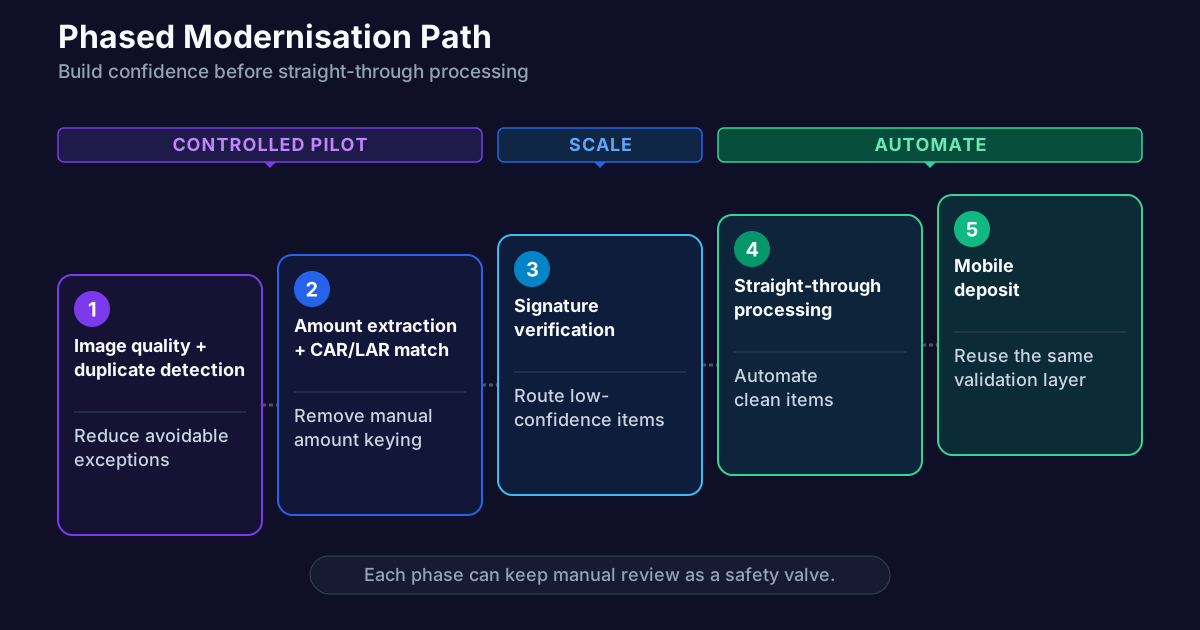
Phase 1: Image Quality + Duplicate Detection
Begin at the capture workstation. Deploy image-quality checks that validate clarity, skew, orientation, correct dimensions, MICR-band visibility, and excessive background noise. Add duplicate detection using image hashing against a rolling window of recently processed items.
Value: Reduce repair-queue volume and prevent duplicate presentment before items enter the clearing pipeline.
Phase 2: Amount Extraction and CAR/LAR Reconciliation
Add courtesy-amount recognition and legal-amount recognition. For handwritten amounts, the model parses both the figures and the written amount, compares them, and flags mismatches for review.
Value: Eliminate manual amount keying and reduce return-item rates caused by data-entry errors.
Phase 3: Signature Verification
Integrate AI signature matching that compares the presented signature against the stored specimen across multiple feature dimensions — stroke pressure, curvature, spacing, and overall morphology. Items below the confidence threshold are routed for manual review.
Value: Speed up verification at busy branches and flag sophisticated forgeries that a human eye would miss.
Phase 4: Full Straight-Through Processing
With validation confidence high enough, items that pass all checks can proceed automatically to the host-file pipeline without human touch. Exceptions continue to flow through the structured repair workflow.
Value: Reduce per-item processing cost by 60-80% while improving clearing speed and audit completeness.
Phase 5: Mobile Deposit and Digital Channels
Add the mobile capture pipeline, validated by the same AI engine, feeding into the same host-file workflow. Customers can deposit cheques from a smartphone; the bank's existing core and clearing systems never need to know the item originated from a mobile device.
Value: Differentiate the bank in the SME and retail deposit market without a parallel infrastructure investment.
Frequently Asked Questions
What is the presenting-bank cheque capture environment in Kenya?
It is the local bank infrastructure that converts a deposited physical cheque into an image-plus-data clearing item for submission through the Kenya Bankers Association Automated Clearing House. It typically includes scanner hardware, a capture workstation, MICR and image validation, a branch transmission queue, central processing services, core-banking integration, and the Sybrin Client Participation Module for clearing-house submission.
Does every Kenyan bank use the same capture software?
No. Sybrin supplied the central clearing system and the participant interface (CPM), but individual banks procured their own capture and imaging systems. Standard Chartered used NCR Kenya; National Bank of Kenya contracted EFT Kenya working with Finteq. Other banks chose their own vendors.
How does Chequedb integrate with Sybrin CTS?
Chequedb sits upstream of the Sybrin CPM. It receives capture data after the scanner and workstation produce the image and MICR data, applies AI validation — handwriting OCR, CAR/LAR reconciliation, signature verification, duplicate detection — and outputs validated records in the host-file or flat-file format that feeds into the bank's existing core-banking and Sybrin pipeline.
Does Chequedb replace the existing Sybrin installation?
No. Chequedb is an enhancement layer, not a replacement. The Sybrin CPM continues to handle clearing-house submission and acknowledgment. Chequedb improves the quality and completeness of the data that feeds into that submission.
Does Chequedb require changes to T24 or the core banking system?
No. Chequedb can read and write the same host-file formats that the bank already uses for T24 integration. No core-banking schema changes are required.
Can Chequedb handle handwritten cheques?
Yes. Unlike generic OCR engines that struggle with cursive handwriting, colloquial amounts, and mixed scripts, Chequedb uses field-specific models trained for cheque handwriting. This includes amounts written in words, payee names, and other handwritten fields common on Kenyan business cheques.
Is on-premise deployment available?
Yes. Chequedb supports on-premise, private cloud, and hybrid deployment models. This is critical for Kenyan banks that must comply with data residency requirements and central bank regulations on where customer data can be processed and stored.
What scanner hardware does Chequedb support?
Chequedb works with the scanner hardware the bank already owns. The validation layer processes the captured image after the scanner produces it — no hardware replacement is required. Existing MICR readers, desktop scanners, and high-speed production scanners feed into the same pipeline.
7. Conclusion
Kenyan banks built a sophisticated cheque clearing infrastructure two decades ahead of many African markets. The Sybrin CTS, the KBA clearing house, the T24 integration, and the heterogeneous capture estate represent a significant operational investment.
The next step is not to replace that investment. It is to add an AI-powered validation layer that fills the gaps the original architecture did not address: handwriting recognition, legal-amount validation, signature verification, duplicate detection at capture time, immutable audit trails, and mobile deposit enablement.
Chequedb is designed to sit alongside existing Sybrin, NCR, Finteq, and T24 infrastructure — consuming capture output and producing validated, audit-ready records that flow into the existing clearing pipeline without disruption.
For banks that want to reduce repair queues, lower return-item rates, speed up clearing, and open mobile deposit channels without a core system overhaul, this is the practical path forward.
For further reading on the Kenyan cheque infrastructure, visit the Central Bank of Kenya and the Kenya Bankers Association.
Ready to explore how this fits your bank's existing infrastructure? See Cheque Management Software for audit workflows, Cheque Data Extraction for OCR and validation, or Bank Check OCR API for API integration.