When a handwritten cheque is hard to read, search history using several available signals, combine the resulting candidates, then rank them with their confidence and any matching or conflicting evidence visible. A partial payee name can still lead to a useful candidate when amount, date context, account details or a cheque-number read also align. The aim is to help a reviewer find the right earlier record, not to turn an uncertain read into an identity claim.
ChequeDB's cheque data extraction workflow reads printed and handwritten payees, amounts, dates and other available fields, with field-level confidence and validation signals. Those values supply additional clues for historical search when the codeline is unclear. Matching uses the clues to locate relevant records for comparison.
Keep each raw read alongside its normalized search value and confidence. Normalization can help compare Acme Tools Limited with ACME TOOLS LTD, but it should never erase what the image actually showed. Case and punctuation changes are different from guessing a missing letter or correcting a recognition error.
Search with multiple clues
A useful search can begin with any field that is available and sufficiently legible: account or routing details from MICR, a cheque number, a payee fragment, a date, an amount, or a linked business reference. Each can narrow the history differently. Account context can distinguish unrelated cheque books; a payee and amount may locate an expected transaction; date context can help separate nearby items. If one value is uncertain, it can broaden retrieval instead of acting as a hard filter that hides a relevant record.
Candidate retrieval and candidate assessment are separate steps. First collect records that match one or more available clues. Then show why each was retrieved: exact or approximate field matches, confidence in the current read, missing information and disagreements. A reviewer can inspect the source images and record history. An unknown field is simply unknown; it does not agree with a candidate by default.
For a searchable archive, this makes historical records useful even when current handwriting is imperfect. The searchable cheque register provides the retrieval context, while cheque management and review connects a candidate with the operational history a team needs to assess it.
Fictional example: an incomplete payee read
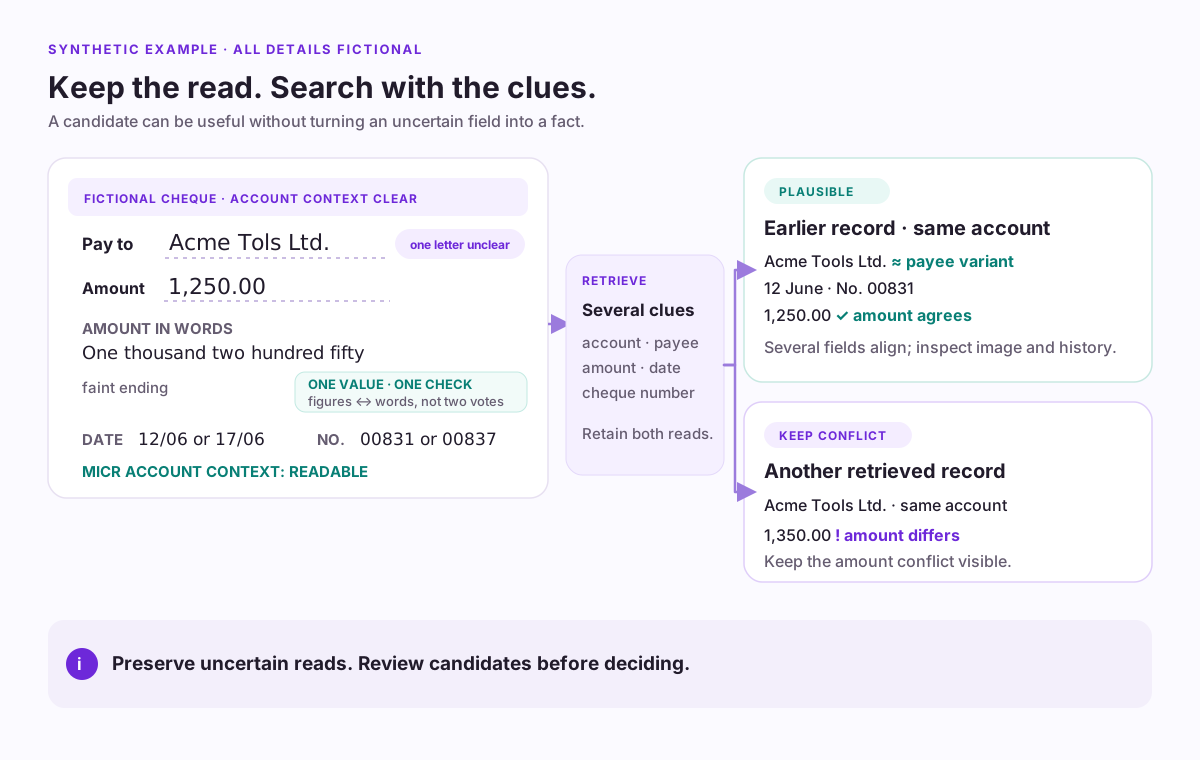
Synthetic example. Amount in figures and words are two representations of one value and serve as a consistency check, not independent matching votes. Retrieved candidates preserve uncertain reads and amount conflicts for human review.
Suppose a newly scanned cheque has a handwritten payee that appears to read “Acme Tols Ltd.” The final letters are unclear. The numeric amount looks like 1,250.00; the amount in words appears to say “one thousand two hundred fifty,” though the last word is faint. The date may be 12 June or 17 June. MICR returns account details clearly, while the cheque number could be 00831 or 00837 because one digit is blurred.
A retrieval process can retain the evidence like this. The uncertainty labels below are illustrative, not model outputs:
| Field | Raw read | Normalized search value | Confidence or state |
|---|---|---|---|
| Payee | Acme Tols Ltd. | acme tols ltd; search Acme Tools Ltd. as a possible variant | Medium; one letter uncertain |
| Numeric amount | 1,250.00 | 1250.00 | High |
| Amount in words | one thousand two hundred fifty | 1250.00 | Medium; faint ending |
| Date | 12/06 or 17/06 | Both plausible dates retained for search | Low |
| Cheque number | 00831 or 00837 | Both readings retained as text | Low |
| Account details | MICR read | Account-scoped value | High |
The numeric amount and amount in words are two representations of one amount, not two independent votes that the historical record is the same cheque. Their agreement is a useful internal consistency check; the uncertainty in the words still matters. The account match can retrieve candidates from the relevant history, while either cheque-number reading, payee variation, amount and date context can contribute additional evidence.
Imagine an earlier authorized record on the same account for Acme Tools Ltd., dated 12 June, with cheque number 00831 and amount 1,250.00. It is a plausible candidate because multiple fields align, but it still needs image and history review. A second record might have the same payee and amount on a different date. That combination alone is not enough to identify one instrument: suppliers can receive repeated payments, and cheque templates may look alike.
If a candidate has amount 1,350.00, retain it when other strong clues justify retrieval and display the amount disagreement clearly. A changed amount could mean a misread, a corrected record, or a genuinely different transaction. Treating it as a conflict helps the reviewer investigate; silently excluding it can hide useful history. Similarly, an unreadable cheque-number digit should remain uncertain rather than being filled in from a convenient candidate.
Handwriting text and visual similarity
Handwriting text recognition reads characters and converts them into field values such as a payee, date or amount. Comparing the appearance of a handwritten region is a different technique: it looks for visual resemblance between image regions, even when the text itself is unclear. Such region similarity could be evaluated as an additional retrieval signal, but it is proposed here as an evaluation idea, not a claim about an available ChequeDB API or feature. Neither text resemblance nor visual similarity establishes who wrote a cheque or whether it is authentic.
The practical foundation is structured, reviewable field extraction. The cheque data extraction overview describes that primary workflow, and the bank check OCR API documentation is the developer entry point for evaluating extraction in an integration. Matching logic should use only historical records and fields the organization is authorized to access; it should not imply universal coverage across banks, channels or archives.
Evaluate retrieval quality
A pilot should measure whether the intended earlier record appears among the candidates, how often unrelated records appear, and how much reviewer effort candidate lists require. Include examples with partial names, uncertain digits, conflicting amounts, missing dates and repeated payments to the same payee. Reviewers should be able to see the raw read, normalized value, confidence, source image and reason each candidate appeared.
Evaluate the workflow on representative, permissioned history and retain human review for consequential decisions. Do not judge it only by whether a name was transcribed correctly: the question here is whether useful prior records are found and whether false matches are manageable. For operational duplicate controls across intake channels, see duplicate presentment detection, which addresses the broader workflow around repeat submissions.
To evaluate candidate retrieval against your authorized cheque history, evaluate handwritten cheque matching with examples of incomplete fields, recurring payments and conflicting amounts.
Frequently Asked Questions
Can a partial handwritten payee still find an earlier cheque?
Yes. A payee fragment can help retrieve candidates when combined with available account, amount, date or cheque-number clues. The result is a candidate list for review, not a confirmed match.
Should amount in figures and amount in words count as two matching signals?
They are two written representations of one amount. Compare them for consistency, but do not count their agreement as two independent proofs that two records are the same cheque.
Does similar handwriting identify the writer?
No. Text recognition and visual similarity can support retrieval experiments, but neither establishes writer identity or cheque authenticity.
What should happen when a field is unreadable or disagrees?
Preserve the raw read and uncertainty, mark missing evidence as unknown, and show material conflicts such as a different amount. A reviewer can then inspect the image and record history.