Duplicate presentment detection asks whether an incoming cheque has already entered a deposit workflow. The second capture may come from a mobile phone, an ATM, a branch scanner or a business deposit batch. Recognising the instrument matters, but operations must also establish what happened to its earlier attempt before deciding how to handle this one.
An exact MICR match is a useful starting point. It is less useful when a mobile crop cuts off the codeline or a scanner misreads one character. ChequeDB's handwritten field extraction supplies additional information: payee, numeric amount, legal amount in words, date, memo and other readable attributes. Those fields can help retrieve related historical records for comparison, even when the codeline is incomplete.
The practical objective is a reviewable connection between captures and authorised history. Finding a related record is not itself a duplicate decision, and a duplicate warning is not proof of fraud.
Cross-Channel Detection Needs Shared History
Mobile capture and branch intake cannot compare their records if each stores a separate history. A connected remote deposit capture workflow needs to make earlier captures, deposit attempts and subsequent outcomes available to the authorised team.
Keep the source channel, capture time, customer or deposit account context, batch reference and available bank outcomes with each attempt. A captured image, a submitted deposit and a cleared cheque are different events. Their timestamps and sources help a reviewer understand whether another image is a rescan, a second deposit attempt or an eligible re-presentment.
This visibility extends only to connected records the organisation is authorised to access. Parsing an image does not reveal a deposit at another bank. A channel excluded from the connected history remains a gap in the check.
Matching a Cheque When the MICR Read Is Incomplete
Use more than one route to retrieve candidates. An exact bank-account-cheque-number lookup can find a strong candidate when those fields are legible. A partial codeline lookup can retain candidates consistent with the readable characters. Separately, combinations such as payee, amount and date, or amount, memo reference and available account context, can retrieve records that an exact MICR lookup would miss.
Combine the candidate sets before ranking them. Requiring every field to agree at retrieval would discard useful evidence: the same cheque might have an uncertain account digit, or a related image might contain a changed payee. Conversely, searching on amount alone could bring back many unrelated items. Set the retrieval scope and search combinations using the authorised archive and the organisation's cheque patterns.
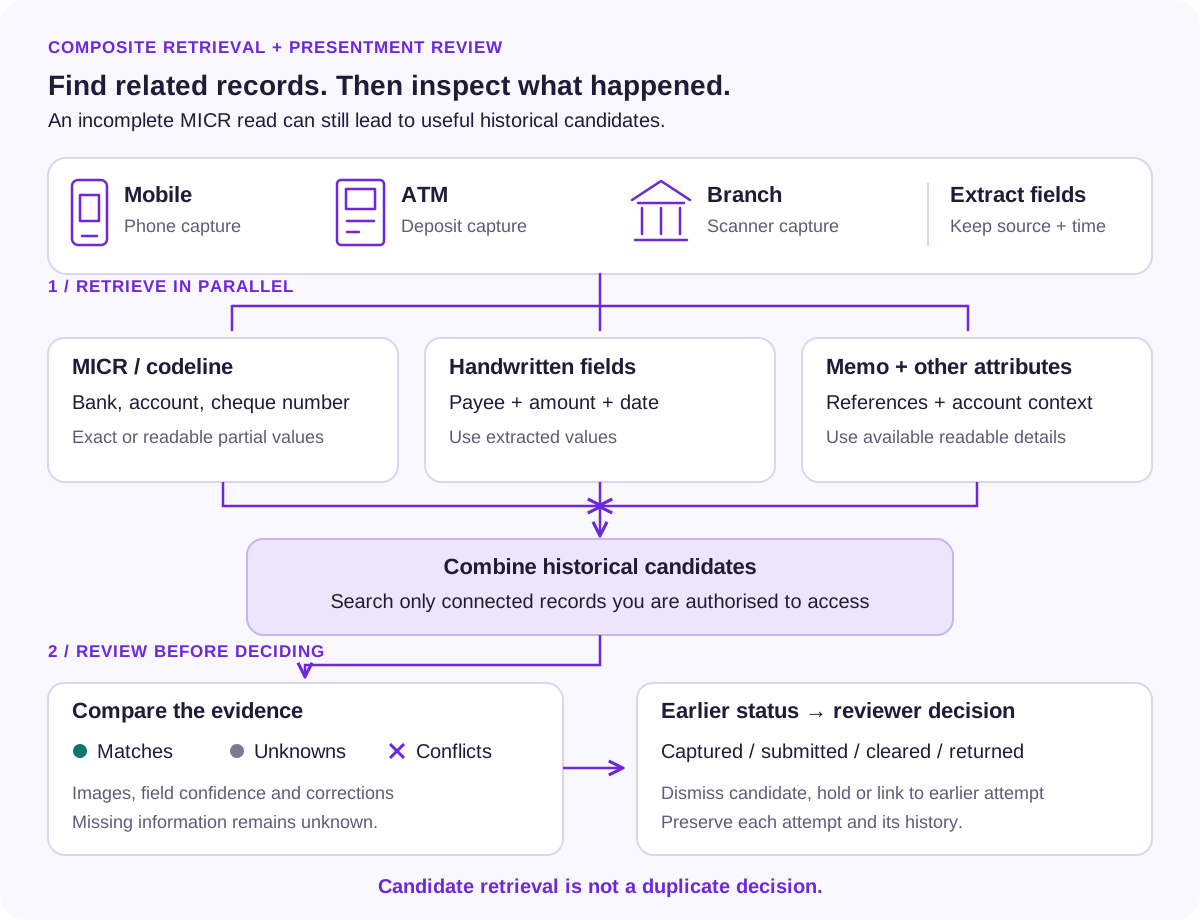
Use parallel field searches to retrieve candidates from authorised connected history. Compare matches, unknowns and conflicts, then inspect the earlier attempt status before deciding how to handle the new attempt.
ChequeDB's cheque data extraction reads printed and handwritten fields into structured records. For this workflow, evaluate how those reads can support retrieval, then compare each candidate field by field:
| Attribute | Comparison to preserve |
|---|---|
| MICR and cheque number | Matching characters, uncertain positions and definite conflicts; retain leading zeros |
| Handwritten payee | Original read, normalized name, confidence and meaningful differences |
| Numeric and written amount | Agreement or conflict between the two representations and the historical value |
| Date | Extracted date, uncertainty and any correction supported by the image |
| Memo and references | Readable payment context; a missing memo remains unknown |
| Other cheque attributes | Drawer text, available back image and visible stamps or endorsements |
Rank candidates using both matches and conflicts, with per-field confidence. A confident account mismatch should carry a different meaning from an unreadable account character. Missing fields are unknown, not agreement. Preserve the original extraction alongside normalized values and reviewer corrections so the ranking can be explained.
Numeric amount and amount in words describe the same payment value. Their agreement helps validate the read, but treating them as two independent confirmations would overstate the evidence. A mismatch between them needs attention even if one representation matches the earlier record.
The handwritten cheque matching article examines this retrieval approach more broadly. Here, its purpose is specific: find the earlier instrument and inspect its deposit history.
Three Synthetic Presentment Examples
These examples are invented evaluation cases, not customer results.
Synthetic example 1: Scanner and mobile capture, uncertain MICR character
A branch scanner records cheque 00926, payable to Cedar Supplies, for 1,800, dated 12 September. A later mobile image reads the cheque number as 009?6. The payee, numeric amount, amount in words and date are legible; the mobile crop obscures one MICR character.
The partial codeline route and a separate payee-amount-date route should both be able to retrieve the earlier record. The comparison shows which fields support the relationship and which character remains unresolved. The reviewer inspects both images and the earlier deposit status before deciding whether this is another attempt on the same instrument. A stored scanner capture alone does not establish that it was paid.
Synthetic example 2: Related candidate with a changed payee and amount
An earlier image has the same readable account and cheque number as a new branch capture. The earlier payee is Cedar Supplies and the amount is 1,800. The new image reads Harbour Services and 8,800.
Keep the earlier record as a candidate because the instrument identifiers connect it. Show the payee and amount as conflicts rather than filtering the record away or averaging them into a reassuring score. The reviewer needs to determine whether extraction failed, an earlier record was corrected, or the image requires investigation. The relationship merits review; it does not establish alteration or fraud by itself.
Synthetic example 3: Different cheques with similar payment details
Two monthly payments use the same bank stationery, payee and amount. Their cheque numbers are 00926 and 00941, and their dates differ. A payee-amount search retrieves both.
Similar layout and payment details do not make these duplicate presentments. The distinct, confidently read instrument identifiers and dates must remain visible. Routine recurring payments should not be collapsed into one cheque record because their handwriting or template looks similar.
Keep Image Comparison Within Its Evidence Limits
An identical file can support identifying a repeated upload. A fresh mobile photograph has different pixels from a scanner image, so file equality will not cover every repeat capture. Front and back images remain useful evidence for a person comparing crops, endorsements and visible changes.
A pilot can separately assess visual similarity of handwriting regions as an additional retrieval method. The synthetic examples here use extracted values and review logic; no visual-similarity model was run. Reading handwritten fields and comparing their extracted values is distinct from comparing handwriting shapes. Neither establishes who wrote the cheque. A candidate rank also should not be described as a calibrated probability of fraud.
Separate API Retries From Deposit Attempts
An integration may resend a request after losing a response. A scanner operator may upload the same batch twice. Neither necessarily represents another presentment to a bank.
For bank check OCR API integrations, agree how request references, source records and retry handling will distinguish a repeated technical operation from a new business attempt. Then perform cheque matching against earlier authorised records. Request deduplication and instrument matching solve related but different problems; no particular API contract should be assumed without checking the integration.
Returned items also need careful treatment. Depending on the return reason, applicable rules and the bank's process, an item may be eligible for lawful re-presentment. Display the previous return event and supporting evidence instead of automatically rejecting every previously seen cheque. Eligibility must be determined under the relevant procedure.
Give Reviewers the Evidence and Preserve Separate Attempts
A useful review shows both images, original and corrected fields, per-field confidence, matching and conflicting values, source channels, timestamps and available deposit outcomes. It should distinguish unavailable history from a confirmed absence of an earlier deposit.
Connect the reviewer decision to the cheque management workflow: why the candidate was dismissed, held for investigation or linked to an earlier attempt, and what processing action followed. Preserve separate attempt identifiers and their histories. Linking related captures should not require an irreversible merge that destroys the distinction between attempts.
For broader outgoing-payment checks, including two cheques for one invoice, see duplicate cheque detection for outgoing payments and incoming deposits. Presentment review focuses on an incoming instrument and its deposit lifecycle.
Bring channel examples and define the available history. Plan a cheque matching evaluation.
Frequently Asked Questions
Can matching work without a complete MICR read?
Other readable fields can retrieve candidates for review. An incomplete MICR read still leaves uncertainty; payee, amount and date alone do not prove instrument identity.
Does a match mean the cheque should be rejected?
No. Inspect the images, conflicts and earlier status. A rescan, technical retry or eligible re-presentment may need different handling from a second deposit of a cleared item.
Can ChequeDB see deposits at every bank?
Comparison depends on connected historical records and authorised access. An image does not supply another institution's deposit history.
What should a matching evaluation include?
Include uncertain MICR reads, changed fields, recurring payments, returned items and repeated requests. Check whether candidates are retrieved and whether reviewers can explain the result.