A cheque OCR proof of concept should show what happens after an image becomes data. Can the team spot a wrong amount, resolve an unclear read and preserve the decision before the item moves downstream?
Start with the work your team needs to improve: re-keying cheque details, moving images between systems or chasing exceptions without enough context. Then test one capture source and one review workflow. A successful read is useful only when the next person or system can use it safely.
This guide follows one fictional cheque through extraction, review and an internal approval decision. It separates an OCR mistake from a genuine disagreement on the cheque. The examples are test designs, not customer results or a live API response.
Choose a small workflow with a clear owner
For a branch pilot, the starting point might be images from an existing scanner and a queue used by an operations team. For a mobile pilot, it might be a phone photo, a retake step and a backend review queue.
Use the capture setup you intend to operate. Confirm the exact scanner, driver or vendor SDK, operating system and image output before assuming compatibility. The scanner integration guide explains that boundary. OCR does not itself control a scanner's feeder, escrow or paper return.
Write down four responsibilities before the test:
| Responsibility | Agree before the pilot |
|---|---|
| Capture | Who produces the images and associates them with the correct item? |
| Extraction | Which fields does the service return, and how are missing values represented? |
| Review | Who can correct a read, resolve an exception and approve the next step? |
| Downstream processing | Which system receives the record and supplies the confirmed posting or bank status? |
The bank check OCR API supplies field extraction for an agreed integration. Your application or the cheque management workflow supplies the ownership and decisions around those fields. Confirm the enabled components and responsibilities for your deployment.
Follow one cheque from image to decision
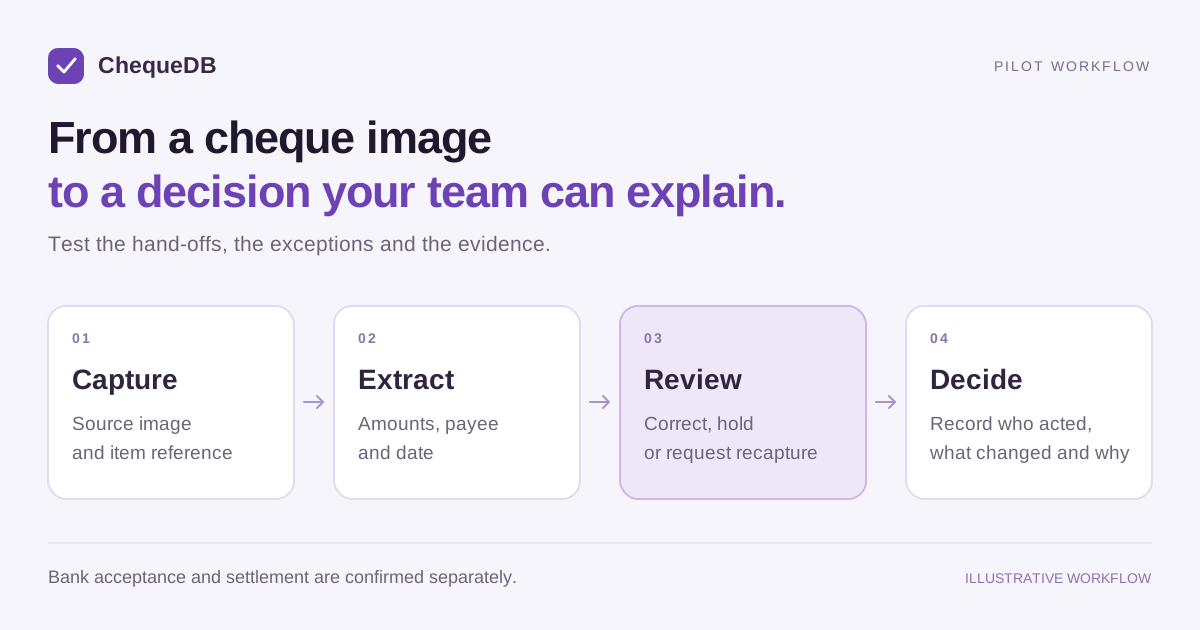
This is a proposed control flow. Test each hand-off, and keep unresolved items on hold. An OCR call supplies fields; the surrounding application must implement the agreed review and approval controls.
Example: Correct an OCR mistake without losing the original read
Use a fictional item called SAMPLE-0042. The source image shows Northstar Supplies as the payee. Its numeric box contains 1,250.00, and its written amount says one thousand two hundred fifty only.
In this test case, the extracted numeric amount is deliberately set to 1,750.00. The written amount is read correctly. This gives the reviewer a specific error to investigate.
| Step | Evidence | Expected behavior |
|---|---|---|
| Capture | Source image and item reference SAMPLE-0042 | Keep the image associated with the processing attempt. |
| Extract | Numeric read 1,750.00; written read equivalent to 1,250.00 | Flag the disagreement and withhold the amount from automatic downstream use. |
| Inspect | The reviewer sees a clear 1,250.00 in the source image | Identify this as a recognition error. |
| Correct | Original read 1,750.00; corrected value 1,250.00 | Record who corrected it, when and why. Preserve both values. |
| Approve | The corrected record and its evidence | Apply the agreed approval policy, including a separate approver where required. |
| Reconcile | A later response from the downstream system | Associate the confirmed reference and status with this item. |
A correction should explain the evidence: for example, “Numeric OCR read corrected to match the clear source image; written amount agrees.” A bare replacement of 1,750.00 with 1,250.00 loses information the next reviewer may need.
After internal approval, the record can be eligible for the agreed next step. It is not yet evidence that a bank accepted the deposit or that funds settled.
Test a genuine amount conflict separately
Now change the fixture. The cheque image itself shows 1,750.00 in the numeric box and one thousand two hundred fifty only in words.
Both OCR reads can be accurate while the cheque remains inconsistent. A reviewer should not “fix” the extracted number merely to make the fields agree. Keep the item unresolved and follow the bank's exception process.
This is the distinction the pilot must demonstrate:
- Recognition error: the extracted value disagrees with a clear source image. An authorised correction can preserve the original read and its reason.
- Source conflict: the cheque contains inconsistent information. Record the conflict and seek an authorised disposition.
- Unreadable source: the image does not support a reliable decision. Request a better capture or retain the item for further review.
Measure these outcomes separately. Combining them into a single error count hides whether the team needs better recognition, better capture or a different operational decision.
Check the record that leaves review
Ask the engineering and operations teams to inspect the same sample record. At minimum, the proposed mapping should identify the source image, item reference, original reads, corrected values where applicable, exception reason and decision history.
Keep an internal approval state separate from a downstream submission state and from a bank-confirmed status. An upload timeout must not silently become a second authorised item. Test how your application reconciles an uncertain submission before retrying it; confirm the actual API's retry and idempotency behavior rather than assuming a header or guarantee.
The cheque data extraction page describes the field-processing boundary. For an ATM project with physical media handling and bank-host decisions, continue with the ATM cheque deposit orchestration guide.
Score the pilot on decisions as well as reads
Use representative, de-identified documents you are authorised to process. Include the layouts, languages, handwriting and image conditions your team receives. Agree the expected values independently, and keep a holdout set separate from material used to adjust the integration.
The handwritten cheque OCR benchmark provides a field-level scorecard. Add these workflow measures:
| Measure | What to record |
|---|---|
| Correct reads by field | Correct values and the total evaluated for each required field. |
| Wrong values accepted without review | Incorrect accepted values and all accepted values, with raw counts. |
| Unresolved items | Items still awaiting evidence or a decision, grouped by reason. |
| Review effort | Time spent investigating, correcting and approving exceptions. |
| Response time | Typical and slower responses under the intended capture and load conditions. |
| Downstream agreement | Whether authorised records, submission results and confirmed statuses reconcile. |
Report sample size, exclusions and the conditions of the run. A small initial pilot can expose integration problems; it cannot establish a universal accuracy or fraud-prevention claim.
Make the rollout decision explicit
Finish with a short decision record: what passed, what failed, who owns the remaining work and which conditions must be met before expansion.
For example, extraction may be usable while reviewer permissions still need work. A scanner may produce acceptable images while reconnect handling remains unreliable. Record those findings separately so a promising OCR result does not hide an unfinished workflow.
To plan a cheque OCR pilot, bring your capture setup, required fields, review rules and downstream destination. Agree the sample set, scorecard, exception walkthrough and integration mapping before starting. If your engineering team needs the provisioned contract first, request API documentation.
Frequently Asked Questions
What should a cheque OCR proof of concept prove?
It should show whether representative images produce usable fields, whether wrong or uncertain reads reach the right reviewer, and whether the authorised record can be passed downstream with its evidence intact.
Can we use our existing scanners?
Evaluate images from the intended devices. Confirm the model, driver or vendor SDK, operating system and output format. Recognition of an image and control of the physical scanner are separate integration questions.
Should a reviewer always replace the numeric amount with the written amount?
The reviewer should first establish whether OCR misread the image or whether the cheque itself contains a conflict. Preserve the evidence and follow the bank's exception policy. Do not silently overwrite a genuine conflict to make the fields agree.
Does a successful OCR result mean a cheque has been deposited?
No. Extraction, internal approval, submission, bank acceptance and settlement are distinct events. Use the responsible system's confirmation for each status.
Does this article publish ChequeDB accuracy results?
No. The worked example uses fictional data and deliberately selected outcomes. Measure performance on an agreed test set using field-level results, unresolved items, false accepts and reviewer effort.